
Custom design or a stock house project? How to choose in Poland
A stock catalogue project is cheaper and faster — and on a standard flat plot it is a sensible choice. A custom design earns its fee where the plot is difficult or the house has to fit a particular way of living. The decision comes down to one question: how much does your plot resemble the one the catalogue project was drawn for?
Stock project vs custom design
| Stock project + adaptation | Custom design | |
|---|---|---|
| Documentation cost | 3,000 – 7,000 PLN + 2,500 – 6,000 PLN adaptation | 18,000 – 45,000 PLN |
| Time | 3 – 6 weeks | 3 – 5 months |
| Fit to the plot | limited | complete |
| Changes to form and structure | need the author’s consent | unrestricted |
| Risk on a difficult plot | high | low |
| View, daylight, privacy | incidental | designed |
First, a Polish specific: adaptacja
A catalogue project is not a document you can submit for a building permit. Every stock project must go through adaptacja — adaptation to your plot, ground conditions and local regulations, carried out and signed by a designer with Polish qualifications, who then carries professional responsibility for it.
This surprises people arriving from other markets. “Buying a design online” still means engaging a local architect. The question is not whether you need one, only how much they end up doing.
When a stock project is the right call
If your plot is flat, rectangular, wide, with good ground conditions and no unusual constraints — and the brief is conventional — a catalogue project will do the job. You pay less, start sooner, and get a house that has been built hundreds of times, so contractors know exactly what to do with it.
That last point is a genuine advantage, not a consolation prize. Repetition lowers execution risk.
When it fails
Catalogue projects are drawn for an average plot. The further yours departs from that, the more gets reworked — and rework has both a price and a ceiling.
Warning signs:
- A slope. Different foundations, different entrance, often an extra storey. The catalogue did not plan for it.
- A narrow frontage. A house drawn for a 25 m frontage will not sit on 18 m without changing the form.
- A view on one side only. The catalogue puts the living room where its designer put it — not necessarily where your lake is.
- Poor ground conditions. A high water table can overturn the structural assumptions entirely.
- Local planning constraints. Roof pitch, building line, maximum height — a zoning plan can rule a specific project out.
Hit three of those at once and the adaptation costs about half a custom design, while compromising on all three.
What a custom design buys
Put simply: a house designed for that plot and for those people.
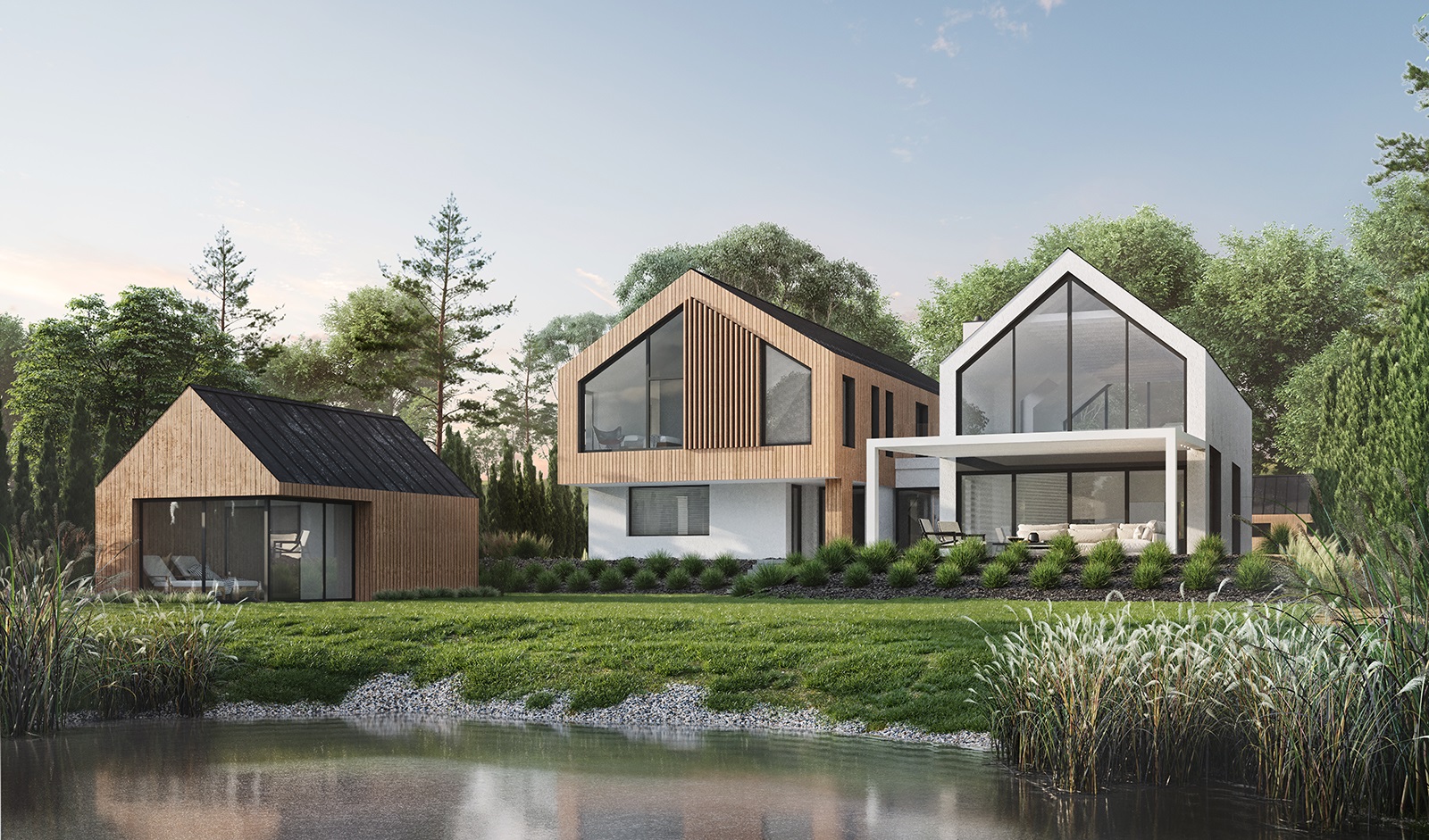
In Lake House the landscape set the terms — a house by a lake in the Tri-City Landscape Park, broken into two volumes joined by a glazed link, with the dining room at the heart of the plan. That cannot be adapted from a catalogue, because the whole concept comes from what is outside the window.
In Black House the T-shaped plan came from the brief: separating the sleeping zone, the garage and a living wing opening onto a panoramic terrace. The black timber façade was a deliberate counter-proposal to the fashion for white houses.
A custom design also gives you control over what a catalogue leaves to chance: daylight, privacy from the neighbour, running costs. A well-oriented house with considered glazing means lower bills for the next thirty years.
Does custom really cost more?
The documentation does — three to six times more. But documentation is 2–4% of the investment.
Count the whole thing. A catalogue project forced onto a difficult plot can add more to the build cost than the entire saving on design: extra earthworks, a re-engineered structure, retaining walls nobody budgeted for. Then there are the costs that never appear in a cost estimate — a house turned away from its view, a living room shaded by the neighbour, a north-facing kitchen.
How to decide
In this order:
- Plot first, house second. Never the other way round. Buy the plot, confirm its planning status, and only then go looking for a house.
- Run a feasibility study. What can be built, where, and under what conditions. A few days of work that sets up everything after it.
- Hold the catalogue up against the result. If it fits without structural surgery, take it. That is the honest answer even though the architect earns less from it.
- If the changes run past a handful, price both routes. An adaptation with a long change list closes in on a custom design — with a worse outcome.
Send us the plot number and we will tell you honestly whether a good stock project is enough in your case. Sometimes it is.
Frequently asked questions
Is a stock house project cheaper than a custom design in Poland?
Yes. A catalogue project costs 3,000–7,000 PLN plus 2,500–6,000 PLN to adapt it, against 18,000–45,000 PLN for a custom design. But that difference is only in documentation, which is 2–4% of the investment cost — the other 96% is governed by how well the house fits the plot.
What is adaptacja, and why does a stock project need it?
Adaptacja is the mandatory adaptation of a catalogue project to your specific plot, ground conditions and local regulations, carried out and signed by a designer with Polish professional qualifications. A catalogue project on its own cannot be submitted for a building permit.
When does a stock house project stop working?
Mainly on a sloping, narrow or irregular plot, in poor ground conditions, or under conservation constraints. Catalogue projects are drawn for an average plot — the further yours departs from that, the more has to be reworked.
How long does adapting a stock project take?
Adaptation usually takes 3–6 weeks, against 3–5 months for a custom design. The authority's decision period comes on top of both.
Can a stock project be modified?
Yes — partition layout, window sizes, materials and services can generally be changed during adaptation. Changes affecting the structure or the external form need the original author's consent, and the more of them you make, the closer the cost gets to a custom design.